
Booking a villa rental in Djerba with a private pool is rarely straightforward the first time. Between cluttered listing platforms, retouched photos, listings without genuine reviews, and price ranges that vary fourfold between seasons, it is easy to get it wrong. This guide has one simple aim: to give you the practical criteria you need to compare, verify and decide with confidence before you book. You will find the questions to ask the property manager, seasonal price ranges, a breakdown of the island’s areas (Midoun, Tezdaine, Houmt Souk, Aghir, Sidi Mahres), an honest comparison between a private villa and an all-inclusive hotel, real-world examples — including our four villas Diamant, Saphir, Opale and Jade in Tezdaine — and the most common pitfalls to avoid. The aim is not to sell you a villa: it is to help you recognise a good villa, wherever it happens to be. For more detail, see Tunisian National Tourist Office (ONTT).
Why choose a private villa rather than a hotel in Djerba
For decades the hotel was the default option for Djerba. Over the past five to seven years, bookings have shifted noticeably towards the private villa — and the trend is moving even faster among Muslim families, couples seeking real privacy, and groups of friends who would rather share a single roof than spread across the floors of a resort. Understanding the practical reasons behind this shift will help you choose well.
Privacy and modesty, especially around the pool
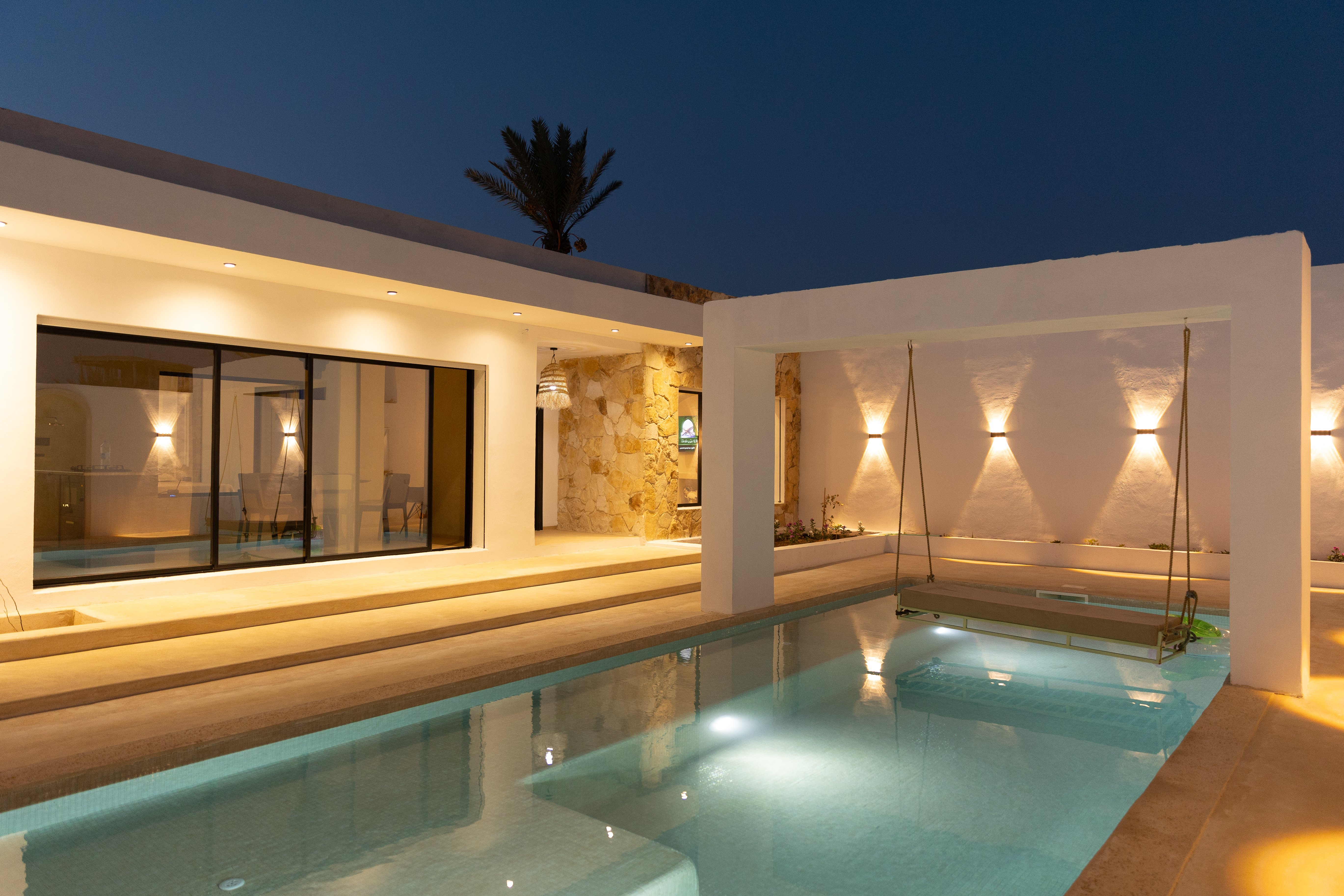
A hotel pool is shared. For many Muslim families — and for many travellers who simply value privacy — that creates a daily problem: women cannot enjoy the water without being watched, children cannot play freely, lunch in swimwear becomes an exposed affair. A villa with a private pool with no overlooking neighbours changes the experience entirely: the inner courtyard, the walls, the arches and the planting form a cocoon where modesty is no longer a constant effort. It is the first reason most of our female guests cite when they explain why they moved away from the resort model.
No alcohol on the premises
Almost every tourist hotel in Djerba serves alcohol around the pool, in the restaurant and at floor bars. For a Muslim family — and for many travellers who simply prefer a calmer atmosphere — that is unwelcome. A well-managed private villa offers a Muslim-friendly environment by default: no alcoholic drinks are served or stored on site, and the atmosphere stays that of a family home. The clarity avoids awkward compromises and lets children grow up in a setting consistent with what they experience at home.
A real working kitchen
The most underrated benefit. A villa with a fully equipped kitchen means the freedom to shop at Midoun market on a Friday morning, to cook a couscous on Sunday with fresh produce, to prepare breakfast at each family member’s own pace, and to manage diets independently (allergies, intolerances, strictly halal, gluten-free, age-appropriate meals for the children). Across a week with a family, it also represents a meaningful saving — often the price of an extra night — compared with the half-board or full-board model of a hotel.
A garden for the children
Children are not built to sit still. In a hotel they are confined to the bedroom, the kids’ club or a supervised pool slot. In a villa with an enclosed garden they run, cycle in the courtyard, kick a football, swim whenever they please, and come back for dinner without anyone needing to track them down across a maze of corridors. For parents, that means real rest rather than constant alertness. For children, it means feeling at home — and that single shift transforms the quality of a holiday.
How to choose a Djerba villa with a private pool: the seven essentials
Once the choice for a villa is made, the real work starts: filtering through hundreds of listings. Here are the seven criteria we systematically recommend our travellers check before they confirm — whether they book with us or anywhere else.
1. The pool: private, yes, but with no overlooking neighbours
The phrase “private pool” is often a marketing trap. A pool may be reserved for your villa and yet be visible from the neighbouring villa, from a shared rooftop terrace, from an upstairs window or from the street. Before you book, ask for photos taken from outside the villa — from the road, from the gate, from the surrounding buildings. If the manager hesitates or refuses, treat that as a signal. A genuinely no-overlooking pool is enclosed by walls or screens at least 2.20 metres tall, with no overlooking windows, and remains usable at any hour by every member of the family.
2. Real sleeping capacity vs advertised capacity
A “villa for 8” tells you very little until you have seen the actual bedroom layout. A villa for eight with four genuine double beds is not the same villa as one with two doubles, two bunks and a sofa-bed in the lounge. Always ask for a precise breakdown: number of bedrooms, bed sizes in each (twin, queen, king), number of bathrooms, presence of a cot, sleeping options for teenagers. For an extended family or a group of friends, this single detail decides the quality of the holiday.
3. Air conditioning and winter heating
Summers in Djerba routinely top 35 °C in July and August, and nights can be stifling. Air conditioning in every bedroom is not a luxury: it is a sleep requirement. Check that it is installed in every bedroom (not only the lounge), that it is recently serviced, and that the villa is properly insulated. Conversely, in winter — December to February — nights drop to around 10 °C: a heating system (reversible AC, radiators, underfloor heating) becomes essential for longer stays. For winter long-stayers it is the single most important criterion.
4. Muslim-friendly amenities
For a Muslim family, several specific amenities transform the experience: a prayer mat in every bedroom, a clearly indicated qibla, a bidet shower (shattaf) in every bathroom, a Qur’an available on request, a kitchen explicitly run as strictly halal (no utensils shared with pork or alcohol), and a mosque close enough for Friday prayers. All of this should be advertised clearly, not added “on request” as an afterthought. If you have to push the manager to confirm any of it, the property has not been designed with you in mind.
5. Position on the island and beach access
Djerba is roughly 27 km east-to-west and 28 km north-to-south. Distances look short on the map, but in peak season the traffic in the Tourist Zone can double the actual driving time. A villa in the centre of the island — typically in the Midoun district, in Tezdaine for example — is 6 to 15 minutes by car from the main beaches (Sidi Yati to the south-east, Sidi Mahres to the north-east, Aghir to the east), while still being clear of resort traffic. A villa in the heart of the Tourist Zone puts your feet in the sand, but cuts you off from the villages and the markets that make Djerba authentic. The geographical compromise is worth thinking through against your daily plan.
6. The kitchen and self-catering autonomy
Check the equipment list: a real electric oven (not just a microwave), a large fridge with a freezer compartment, working hobs, a functioning extractor fan, a dishwasher for larger families, enough utensils (frying pans, saucepans, chopping boards, knives), and a coffee machine or kettle to match your habits. An under-equipped kitchen turns the freedom of a villa into a daily burden. Ask for detailed kitchen photos before you book.
7. Parking, Wi-Fi, security
Three apparently secondary points that make a real day-to-day difference. Private, covered, gated parking prevents finding your car at 60 °C after a summer afternoon in the sun, keeps your luggage safe, and shields the bodywork from sea-air corrosion in winter. Reliable, fast Wi-Fi has become essential, even on holiday — if only for occasional remote work or the children’s quiet hours. Security, finally, is verifiable: a closed gate, a caretaker or on-site team, an alarm, the immediate neighbourhood. An isolated villa at the end of an unmonitored track does not offer the same peace of mind as a managed residence.
Prices and budget: how much does a Djerba villa cost
Prices for a Djerba villa rental with a private pool vary widely by season, capacity and quality. Below are indicative ranges observed across the 2026 market for a properly equipped villa with a private pool. They are reference brackets — exact rates for Ethic Village Djerba are visible in real time on each villa page. Bookings are taken in EUR; the indicative GBP range below assumes an exchange rate around £1 = €1.16.
| Season | Period | Per night (€) | Per night (£ approx.) | For one week (7 nights) | Notes |
|---|---|---|---|---|---|
| Low season | Nov–Mar (excl. holidays) | €120–220 | £105–190 | €800–1,500 | Ideal for winter long stays |
| Shoulder | April, May, October | €180–320 | £155–275 | €1,200–2,200 | Best value for money |
| High season | June, September | €280–450 | £240–390 | €1,900–3,100 | Warm sea, beaches still calm |
| Peak | July, August | €400–700 | £345–605 | €2,800–4,900 | Book 4–6 months ahead |
The variation within each bracket reflects capacity (a six-sleeper villa structurally costs less than a ten-sleeper), the quality of the fit-out (recent AC, good outdoor furniture, child-friendly equipment, dedicated prayer space), and the position (Tourist Zone beachfront villas sit at the top end, while authentic villages such as Tezdaine offer the strongest value-for-money thanks to their setting).
What is included, what is not
The headline rate is rarely the full picture. Before comparing two villas, ask for a precise list of what is included: bed linen and towels (usually yes — verify), arrival and departure cleaning (always), mid-stay cleaning for longer bookings (usually paid), water and electricity (usually included — confirm), Wi-Fi (confirm), pool access (yes), welcome basics (soap, toilet roll, salt, oil — verify).
The most common paid extras are airport transfers (typically €25–50 per leg depending on distance), local car hire (from €35–60 per day), breakfast delivery (€5–12 per person), a chef or a traditional meal cooked on demand, a pre-stocked fridge for arrival (charged at supermarket cost plus a small service fee), childcare or babysitting, and daily housekeeping if requested.
When to book and how far ahead
The rule for Djerba mirrors that of any Mediterranean destination, with one twist: peak season is heavily concentrated and the best villas go very fast.
For a July–August stay
Book ideally between January and March of the same year. Quality villas — those with a no-overlooking pool, full equipment and a strong reputation — are sometimes taken from November of the previous year, especially the larger ones (8 to 10 sleepers) sought after by extended families. Booking in May or June for August means settling for what is left, which is often the less well-equipped or more remote villas.
For a May, June, September or October stay
Two to four months ahead is enough. These are the most pleasant windows of the year (mild climate, quiet beaches, reasonable rates) and demand is strong but less concentrated than mid-summer. May and June are the sweet spot: sea around 22-24 °C, full sun without the heatwave, terraces still bearable in the evening.
For a winter long stay (October to March)
Wintering in Djerba has become a proper trend, particularly among retired travellers, remote workers and Muslim families who want to spend the religious holidays in a calm setting. Two to three months ahead is enough to have real choice. Stays of one month or longer almost always benefit from a sliding discount (10 to 25 % off depending on length). For the full picture see our long-stay guide.
Deposit and cancellation policy
The market norm in Djerba is a 25 to 30 % deposit at the time of booking, with the balance due either before or on arrival depending on the manager. Be very wary of listings that demand 100 % up front several months ahead: it is not standard, and represents an outsized financial risk for you. Check the cancellation terms too: flexible (full refund up to 30 days before), moderate (partial refund), or strict (no refund). For a booking made several months ahead, anything less than moderate should be questioned.
Location: which areas of Djerba to choose
Djerba is not a uniform block. Depending on the area you choose, your holiday will look very different. Below are the four main zones where villa supply is concentrated, with their genuine pros and cons, so you can match the project to the right geography.
Midoun and Tezdaine — authentic balance
The Midoun municipality, on the east coast, is the traditional heart of the island. Its Friday market is one of the most colourful in Tunisia, its olive groves blanket the inland, and this is where the finest menzels are found — the courtyard farmhouses that define rural Djerba. The neighbourhood of Tezdaine (“the palm trees” in Berber) sits within Midoun as a sought-after residential area, away from the resorts but close to everything: 6 minutes by car from Sidi Yati beach, 10 minutes from Midoun centre, 15 minutes from the Tourist Zone. This is where we set up Ethic Village Djerba. Pros: authenticity, calm, real village life, fast access to beaches and shops. Limit: if you want your feet in the sand the moment you wake, this area is not the strongest pick.
Houmt Souk — the historic capital
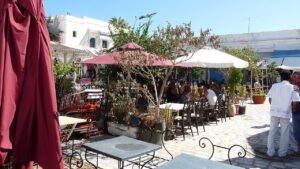
Houmt Souk, in the north-west, is Djerba’s administrative capital. Its daily fish market, its medina, its whitewashed alleys and its Ottoman fort (Borj el-Kebir) make it a vivid, photogenic centre. Pros: urban atmosphere, dense local life, good restaurants, crafts. Limits: private-pool villa supply is rarer and pricier than in Midoun, and the immediate beaches are less attractive than those on the east coast.
Sidi Mahres and the Tourist Zone — feet in the sand
The Tourist Zone runs along the north-east coast, between Houmt Souk and Midoun, behind the long Sidi Mahres beach. This is where the large hotels cluster, with a few beachfront villas. Pros: direct beach access, shallow water 50 to 100 metres out (ideal for younger children), animation. Limits: tourist density, a more “resort” atmosphere than authentic Djerba, peak-season traffic, little quiet. For Muslim families who care about privacy, the immediate proximity of bars and busy hotel beaches can be a real downside.
Aghir and the south-east coast — lagoon and nature
The Aghir area, on the east, extends the Tourist Zone southwards along a coastline that grows quieter the further down you go. Further still, towards Borj Kastil, you reach the protected lagoon and the flamingos. Pros: nature, calm, wilder beaches. Limits: distance to shops, a more scattered villa supply, fewer services nearby. A good fit for couples or travellers who put nature ahead of practicality.
One last note on logistics: whichever area you pick, plan for a hire car. Public transport on Djerba is light, taxis are inexpensive but not always available at quieter hours, and bikes only cover short distances. A hire car turns the geography of the island into a strength rather than a constraint, especially when you choose a villa away from the resort strip.
Honest comparison: private villa vs all-inclusive hotel in Djerba
Both formats have genuine merits. The table below compares them honestly so you can decide based on your profile (family, couple, group of friends, long stay). For a deeper comparison through the Muslim-friendly lens, see our dedicated piece private villa vs hotel in Djerba.
| Criterion | Private villa with pool | All-inclusive hotel |
|---|---|---|
| Privacy | Total (enclosed garden, private pool) | Limited (shared pool, hotel floors) |
| Modesty around the pool | No constraint, enclosed space | Difficult in a mixed setting |
| Alcohol on the premises | None (Muslim-friendly residence) | Present (bars, restaurants) |
| Kitchen | Equipped, full self-catering | Restaurant on fixed hours |
| Space per person | 120–180 m² + garden | 20–40 m² (standard room) |
| Per-person cost (family of 6) | Often more affordable | Often more expensive in peak season |
| Animation / entertainment | None (you are at home) | Evening shows, kids’ clubs, sport |
| Full board included | No (organise or order) | Yes |
| 24/7 hotel service | On-site team, office hours | 24/7 reception |
| Suitable for long stays | Excellent (1 week to 3 months) | Limited (fatigue after 10 days) |
| Suitable for infants | Excellent (kitchen, calm, space) | Variable by hotel |
In short: the villa wins for families, couples seeking privacy, groups of friends and any longer stay. The hotel keeps its strengths for travellers who want zero logistics, who enjoy organised group life, and who stay less than a week.
Real-world examples: the four Ethic Village Djerba villas
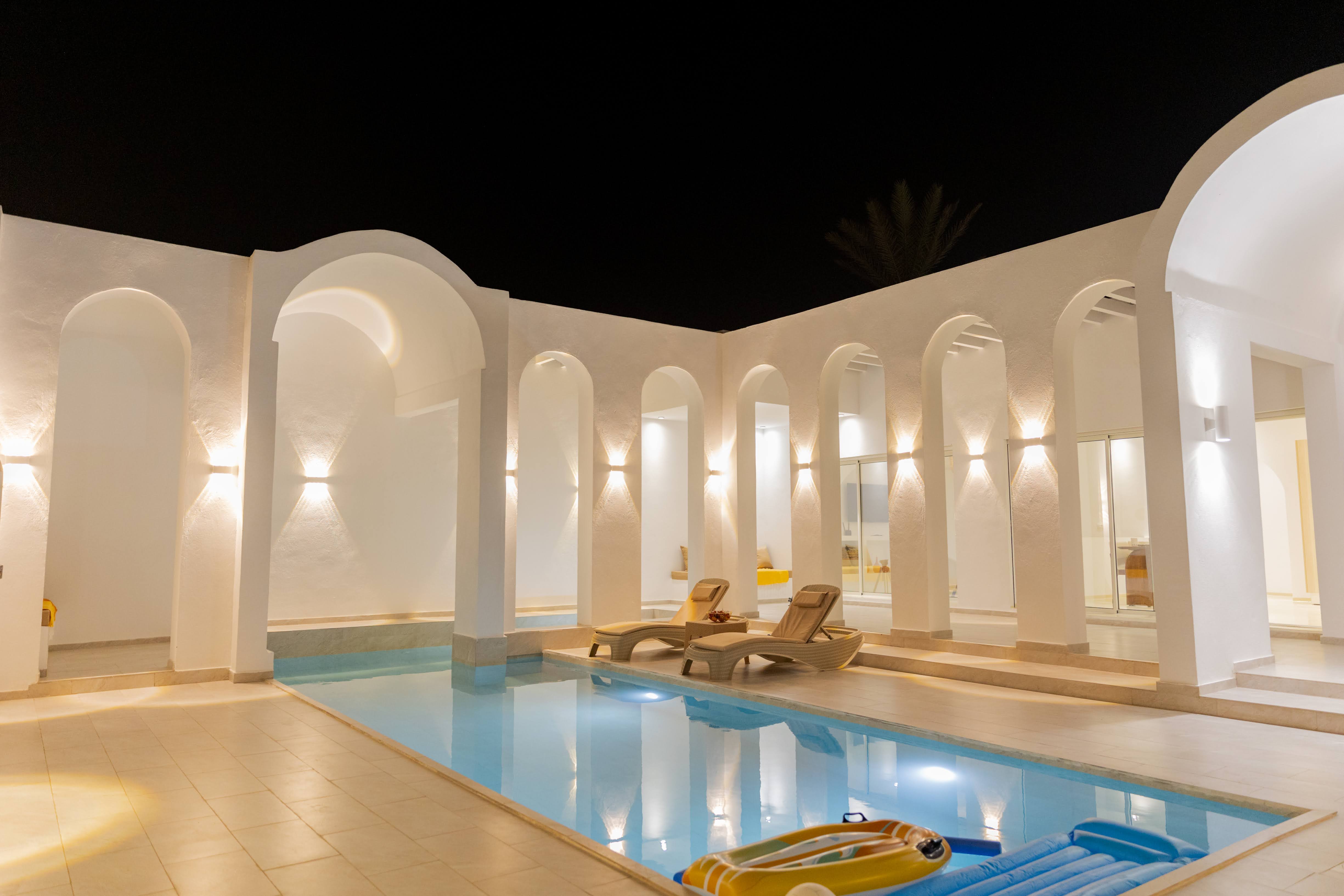
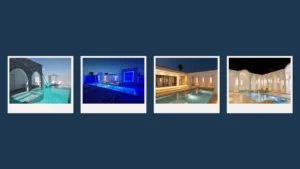
To make the points above concrete, here is how our four villas in Tezdaine break down. They share the same baseline: private no-overlooking pool, equipped kitchen, air conditioning in every bedroom, secure covered parking, Muslim-friendly amenities (prayer mat, qibla, shattaf), unlimited Wi-Fi, on-site team. They differ on capacity, surface area and layout.
| Villa | Sleeps | Surface | Pool | Best for |
|---|---|---|---|---|
| Diamant | 10 | 180 m² | Pool with slide, paddling area and arches | Large families, two families together |
| Saphir | 8 | 150 m² | Pool with outdoor lounge area | Standard family, group of friends |
| Opale | 7 | 135 m² | Pool with hanging swing | Family with young children, enhanced privacy |
| Jade | 6 | 121 m² | Pool with arches and night lighting | Smaller family, couple on a long stay |
The four villas sit within the same residence, in Tezdaine, which makes it possible to combine two or three villas for a multi-family stay while keeping each household fully autonomous. For detailed photos, live availability and live rates, see our villas overview page.
Questions to ask before you book
Below is the checklist we recommend you systematically run through with any property manager or owner before confirming. If an answer is delayed, vague or evasive, treat that as a signal.
- Is the pool genuinely without any overlooking at any hour of the day? Could you send photos taken from outside the villa?
- What is the precise bedroom layout (number, bed sizes, attached or shared bathrooms)?
- Is air conditioning installed in every bedroom, and has it been serviced recently?
- Is there a prayer mat, a clearly indicated qibla and a shattaf in every bathroom?
- Is the residence strictly alcohol-free, including the neighbouring villas?
- What exactly is included in the rate (linen, cleaning, water, electricity, Wi-Fi)?
- What are the paid extras and their prices (transfer, car, chef, mid-stay cleaning)?
- Will an on-site team be available during my stay, and at what hours?
- What is the deposit and cancellation policy in case of an unexpected change of plans?
- May I see recent and verifiable Google reviews?
Common mistakes to avoid
Seven traps come up time and again in the feedback of disappointed travellers in Djerba. Knowing them in advance makes them easy to avoid.
Booking too late for peak season
The most common mistake. For July-August, the best villas are taken six to eight months ahead. Booking in May for August means accepting what is left — usually villas with overlooking pools, ageing AC or borderline capacity.
Trusting the headline price without reading the small print
The advertised per-night price does not always include final cleaning, the security deposit, service fees, child surcharges or local taxes. Always ask for an itemised quote before comparing two listings.
Skipping the Google review check
Reviews on listing platforms can be filtered or curated. Google Business reviews, by contrast, are public, dated and impossible to delete for a dishonest manager. A serious residence has 50 to 300 Google reviews accumulated over several years, with an average above 4.5/5. No Google reviews — or 80 % of them dated within the last few months — is a red flag.
Confusing “private pool” with “assigned pool”
On some platforms, “private pool” actually means “pool assigned to your unit” — that is, a pool visible from a neighbouring unit, an upstairs balcony or the street. Always ask for photos of the pool taken from outside.
Underestimating distance on the island
A beautiful villa 35 minutes from the beaches, with no car on site, quickly becomes a logistical trap. Verify the actual distance (on Google Maps at peak hour) before confirming.
Paying 100 % several months upfront
No legitimate reason justifies a manager demanding 100 % of the price six months ahead. The norm is a 25 to 30 % deposit, with the balance due close to or on arrival. Anything beyond that should come with a clear written justification.
Choosing a villa with no reachable contact
If you wait two days for a reply before booking, picture the situation if something goes wrong on site (a leak, an AC breakdown, a noisy neighbour). A serious manager replies within 24 hours, and gives you a direct WhatsApp or phone number for emergencies during the stay.
Frequently asked questions
What is the average price of a villa rental in Djerba?
For a properly equipped private-pool villa in Djerba, expect €120–220 per night in low season (November-March), €180–320 in shoulder season (April, May, October), €280–450 in high season (June, September), and €400–700 in peak season (July-August). Indicative GBP brackets sit at roughly £105–605 per night across the full year. Long stays usually benefit from a sliding discount. Paid extras (airport transfer, car hire, meals, mid-stay cleaning) come on top of the base rate.
When should I book a Djerba villa?
For July-August, book ideally between January and March. For May-June and September-October, two to four months ahead is enough. For a winter long stay (October to March), two to three months ahead leaves real choice. The rarer the villa (8-10 sleepers, full equipment, no-overlooking pool), the earlier you should book.
Is a deposit required at the time of booking?
The market norm in Djerba is a 25 to 30 % deposit at the time of booking. The balance is due either before or on arrival depending on the manager. Any request for 100 % several months upfront is non-standard and should be challenged. A security deposit (typically €200–500, refunded on departure after inventory) may also be requested separately.
Do all Djerba villas have a fully equipped kitchen?
Most Djerba rental villas come with an equipped kitchen, but the level of equipment varies enormously. Always check for the presence of an electric oven (not just a microwave), a large fridge, working hobs in good condition, and enough utensils to cook properly. Asking for detailed kitchen photos before you book is a useful test of the manager’s transparency. Families travelling with younger children should also check for high chairs, a baby bath if needed, and a microwave separate from the oven.
How do I check the authenticity of a Djerba villa listing?
Four simple checks: (1) search the villa or manager’s name on Google Reviews — a serious residence has at least 50 reviews built up over several years; (2) ask for a quick video call or for fresh photos taken on demand to confirm the villa actually exists; (3) check that the official website has a coherent domain and a valid HTTPS certificate; (4) never pay by direct bank transfer to a personal account — prefer a platform with escrow protection or a manager who offers a secure online payment.
Going further
Choosing a villa in Djerba is less a matter of luck than a matter of method. With the right criteria and the right questions, the great majority of disappointments can be avoided. If you want to explore our four private no-overlooking-pool villas in Tezdaine — Diamant, Saphir, Opale and Jade — with live rates and live availability, see our villas overview page. To understand the geography of the island before picking your area, take a look at our map of Djerba. And for the more practical questions about the stay, our FAQ answers most of the usual queries. We look forward to welcoming you to Tezdaine.