Planning a family holiday to Djerba but wondering whether it is truly safe? Many British, American and Gulf families ask this before booking. This guide gives a frank, evidence-based answer on whether Djerba is safe for families in 2026 — covering advisories, crime, health, transport, women and children, Ramadan and halal food — so you can decide with confidence for your next halal-friendly family holiday at Ethic Village Djerba. See also Djerbahood project by Galerie Itinerrance (the original curators).
Is Djerba Safe for Families in 2026? What Official Advisories Say
Djerba is a small island off southeastern Tunisia, linked to the mainland by a Roman causeway. The UK FCDO and the US State Department both place Tunisia under an exercise caution posture, with specific warnings on the Libyan border and remote southern desert — regions hundreds of kilometres from the island. Djerba itself is treated as a standard tourist zone, like most of coastal Tunisia. The French and German foreign ministries take a similar line. Check the advisory matching your passport before departure, as they are updated regularly.
The 2023 Attack at the Ghriba, and the Political Situation
We have to talk about it, because it is probably what came back to you when you typed “Djerba” and “safety”.
The Ghriba is a synagogue in Djerba, at Erriadh, regarded as one of the oldest on the African continent. A Jewish community still lives on the island, and the annual Lag BaOmer pilgrimage normally draws several thousand participants, notably from France, Israel and other European countries.
On 9 May 2023, during that pilgrimage, a man opened fire near the synagogue. Five people were killed — two visitors and three members of the security forces — and nine were wounded. The attacker was shot dead. He was a serving member of the National Guard, posted to the naval centre at Aghir, who first killed a colleague and took his ammunition before making his way to the site. The Tunisian authorities have never made public a definitive finding on his motive, and no group has claimed the attack.
It was a tragedy. People died coming to pray, and others died protecting them. There is no other way to tell it.
One piece of context, which we set down without drawing the conclusion for you, and without leaving anything out. Djerba has seen two serious attacks in twenty years, and both struck the same place: the Ghriba. On 11 April 2002, a truck bombing there, claimed by Al-Qaeda, killed twenty-one people — fourteen German tourists, two French and five Tunisians. What can be said, and nothing beyond it, is that the island’s residential and tourist areas were not targeted over that period. What cannot be said is that Tunisia was spared: in 2015 the Bardo Museum and Sousse attacks — the latter aimed explicitly at tourists — struck the country, elsewhere than on the island.
As for the pilgrimage, it has been held every year since, but on restricted terms: in 2024, the religious rites only, festivities cancelled; in 2025, open only to Jews resident in Tunisia; in 2026, open again to participants from abroad, under reinforced security.
None of this is a consolation for those who were targeted, and we do not present it as one. These facts say only what this event was, and what it was not.
On politics more broadly: demonstrations, when there are any, are concentrated in the capital and on domestic matters. Djerba lives at a different rhythm. Current advice for your passport: UK FCDO Tunisia travel advice.
Crime in Djerba: What to Expect
Petty crime exists in Djerba as it does anywhere: currency and taxi scams, touts who can be insistent around Houmt Souk, pickpocketing in crowded tourist places — markets, medinas, hotels, beaches.
We have no statistics comparing crime in Djerba with cities back home, and we are not going to invent any: Tunisian figures are not published in a form that allows the comparison.
The precautions are the ones you would take on any trip. Bag closed in the souks, documents and cash in the villa safe, fare agreed before you get into a taxi. Quiet, isolated streets are best avoided after dark, particularly on your own.
Health, Pharmacies and Medical Facilities
The island’s main hospital is the Sadok Mokaddem regional hospital in Houmt Souk, which has an emergency department. Private practices and clinics are spread across the island as well. Pharmacies are widespread and well-stocked; most pharmacists speak French, many English. No special vaccinations are required, the island is malaria-free, with no significant tropical disease risks.
Tap water is fine for washing; we recommend bottled water for drinking (inexpensive, everywhere). Sun protection matters — over 300 days of sunshine a year, so high-SPF cream and hats for the little ones. Before you travel, check what your own situation actually covers for care abroad — many families find out at the wrong moment. Access to care on the island itself is straightforward.
Getting Around Djerba with Children
- Taxis: affordable and widely available. Confirm the fare before setting off or insist on the meter. Child seats are uncommon — bring your own if needed.
- Car rental: available at the airport. Roads are good, though driving styles are more assertive than in northern Europe — stay alert at roundabouts.
- Private transfers: at Ethic Village Djerba, we can arrange an airport transfer on request (paid service).
Houmt Souk, Midoun and Aghir are all 15–20 minutes apart. Our residence sits in Tezdaine, a sought-after quarter of Midoun (Tezdaine means “the palms” in Berber).
Women, Solo Mothers, Ramadan and Cultural Etiquette
Djerba is one of the easiest destinations in the region for women travelling with children or on their own. Tunisian society is broadly respectful; women wearing hijab or niqab blend in effortlessly, and those who do not are equally welcome. Unwanted attention is rare and almost always verbal — a firm polite response settles it. During Ramadan, local establishments stop serving during daylight hours; hotels and restaurants in the tourist areas keep their kitchens open, so you will always find somewhere to eat with the children. Life shifts to the evening, with lively iftar gatherings. Non-Muslim visitors are not expected to fast — just avoid eating ostentatiously in the street during fasting hours. At religious sites, dress modestly: shoulders and knees covered.
Halal Food: No Certification Anxiety
Tunisia is a Muslim-majority country, so all meat is halal by default. You do not need labels or anxious ingredient checks. From local brik to grilled fish on the beach, fresh souk produce and neighbourhood bakeries, what your family eats is halal.
Emergency Numbers to Save Before You Travel
- Police: 197
- National Guard: 193 — it covers what the police do not: the villages and the rural parts of the island.
- Medical emergency (SAMU): 190
- Civil protection / fire: 198
- UK Embassy Tunis: +216 71 108 700
- US Embassy Tunis: +216 71 107 000
A Halal-Friendly Residence That Makes Safety Tangible
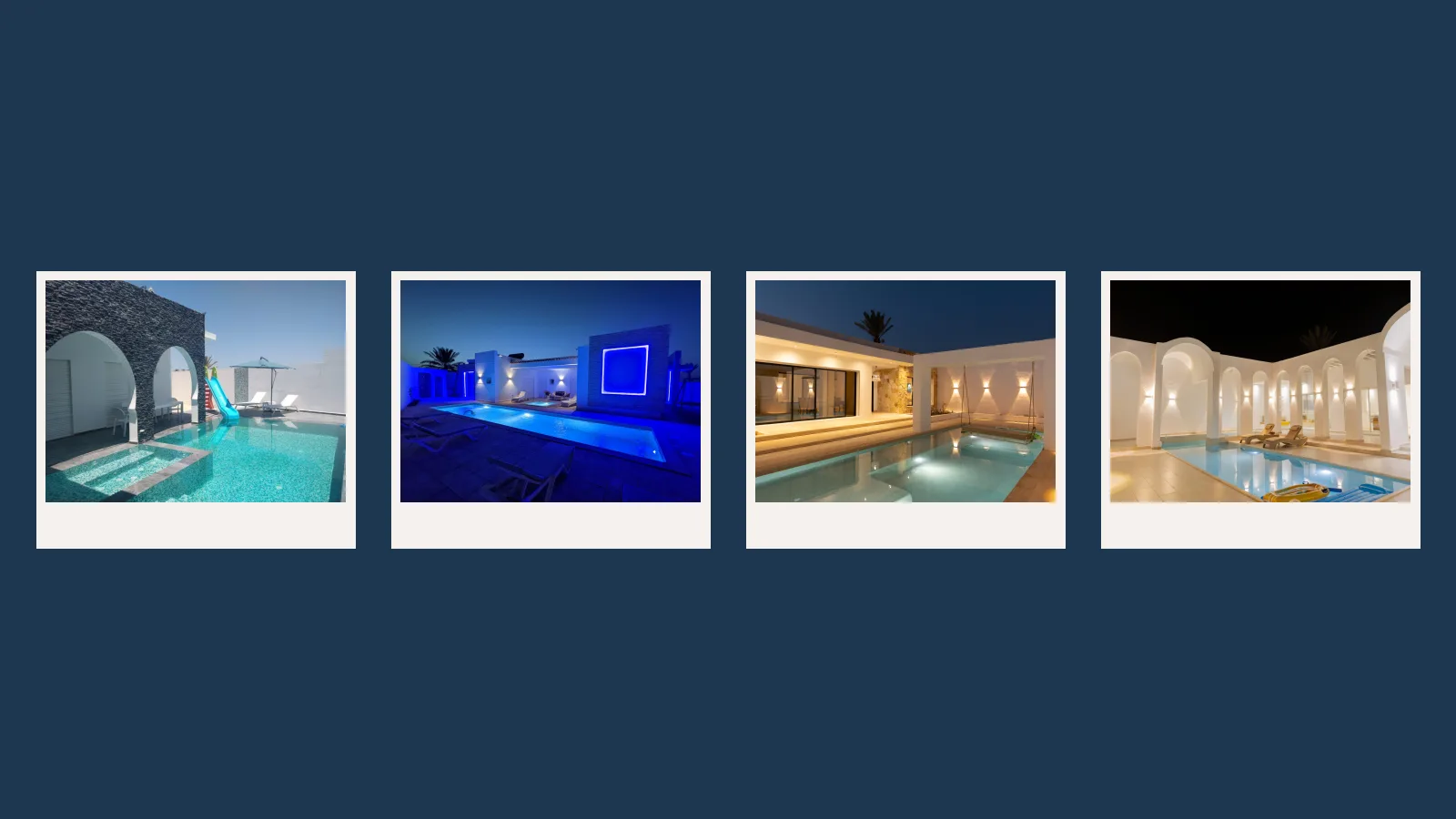
Many families — especially Muslim families — prefer the privacy of a self-contained villa to a hotel. Ethic Village Djerba is a private family residence in Tezdaine, Midoun, not a hotel. 4 villas — including Villa Diamant and Villa Saphir — protected by high walls and greenery, each with a secluded private pool, all strictly alcohol-free by house rules (no exception). Every villa comes with prayer mats and Qibla direction in each bedroom. The Troujette mosque is about 10 min away on foot, the Khalid Ibn Al Walid mosque about 15 min. The welcome meal is offered, and so is breakfast, as a basket that you put together the evening before with a budget of €1 per person per day and that we deliver to your villa in the morning; anything beyond the basket budget is added to your bill. More context in our guides on private villa versus hotel for Muslim families, our practical family guide to Djerba and why Djerba is a quiet favourite among Muslim travellers.
Frequently Asked Questions
Is Djerba safe for British and American tourists in 2026?
Yes. Djerba is not in the specific warning zones of the UK FCDO or US State Department advisories, which focus on the Libyan border and southern desert. Strong security presence, over a million international visitors a year.
Can I find halal food easily in Djerba?
Yes — all meat is halal by default across the island. Restaurants, markets and street food vendors all serve halal, no certification check needed.
Is Djerba suitable for families with young children?
Very much so. Shallow sandy beaches, relaxed pace, locals who are genuinely fond of children. A private villa with a pool gives toddlers a safe enclosed space to play.
What happened at the Ghriba in 2023?
On 9 May 2023, during the annual pilgrimage, a man opened fire near the synagogue at Erriadh. Five people were killed — two visitors and three members of the security forces — and nine were wounded; the attacker, a serving member of the National Guard, was shot dead. No motive has been made public and no group has claimed the attack. The same site had already been struck on 11 April 2002 by a truck bombing claimed by Al-Qaeda, which killed twenty-one people. The pilgrimage has been held every year since, on restricted terms and under reinforced security. We set the facts down as they are; what you make of them for your own trip is yours to decide.
A Peaceful Family Holiday, on Your Terms
Djerba is one of the calmest corners of the Mediterranean for families who value safety, halal food and cultural warmth. The answer is clear: yes, Djerba is safe for families, provided you apply the same common sense you would anywhere else. Browse our halal-friendly private villas and start planning your family escape at Ethic Village Djerba — get in touch whenever you are ready.