Eid al-Adha — or Eid al-Kebir as it is commonly called in Tunisia — is the most important religious festival in the Muslim calendar. In 2026, it falls around May 27 (subject to lunar observation confirmed by Tunisian religious authorities). For travellers discovering Djerba during this period, these few days have a distinctive feel that this article invites you to understand.
What Eid al-Adha is
Eid al-Adha commemorates the moment when the prophet Ibrahim, tested by a vision, agreed to sacrifice what was most precious to him. At his gesture of submission, a ram was substituted for the trial. Since then, every Muslim family with the means honours this memory through the ritual sacrifice of a sheep (usually a ram or mutton).
Eid al-Adha falls on the 10th day of Dhul-Hijja, the last month of the lunar calendar. Its date shifts by ten to twelve days each year relative to the solar calendar.
The days leading up to it
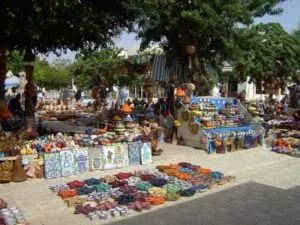
In the days leading up to Eid, Djerba’s atmosphere shifts. The markets fill with supplies — spices, vegetables, drinks. The streets echo with the calls of herders bringing their sheep to the livestock markets. Every neighbourhood discusses preparations, negotiates with breeders, and readies the home.
The livestock markets set up just outside the villages are busy for several days in advance. Sheep prices in Tunisia range from €200 to €450 depending on size and breed — significantly less than in Europe, where logistics and intermediaries multiply the cost.
The morning of Eid
The morning of the first day begins early. Around 6:30 AM, the mosques come alive: the Eid prayer is congregational, and the faithful attend in new clothes — djellabas for men, traditional or contemporary outfits for women.
In Tezdaine (The Palms in Berber), the two neighbourhood mosques — Troujette, a three-minute walk and Khalid Ibn Al Walid, five minutes — welcome the residents. The atmosphere is sober and focused, then families return home.

The sacrifice — between rite and transmission
After the prayer, the sacrifice takes place in the family courtyard or at a neighbour’s with more space. Any adult Muslim may perform the sacrifice; tradition often gives this role to the head of the household, sometimes assisted by an experienced relative. The rite follows precise rules: the sheep is oriented towards the Qibla, the Basmala and Takbir are recited, and a swift incision prevents any unnecessary suffering to the animal.
For children, it is often a significant moment — sometimes difficult, often educational. Most families consider that witnessing the rite, understanding where the meat comes from, is part of the transmission of values.
The sharing — one third, one third, one third
Muslim tradition recommends dividing the meat into three parts:
- One third for the family — consumed over the following days
- One third for neighbours — distributed as fresh portions by the lady of the house
- One third for those in need — given directly, or handed to a local association for redistribution
This rule makes Eid al-Adha a deeply collective celebration. Neighbourhoods communicate, communities help each other, and no one — in principle — is left without meat on this day.
“Eat, feed others, and store.”
— Saying of the Prophet ﷺ, reported by Muslim
This hadith, spoken about the meat of sacrifice, captures the spirit of Eid al-Adha: generosity is not an accessory to the rite — it is its heart. The sacrifice has no meaning without sharing.
Traditional dishes during Eid in Djerba
The first days are a culinary celebration. Among the most common dishes:

- Mloukhia — jute leaves stewed with the noble cuts
- Couscous with meatballs — rich and generous, for family gatherings
- Ojja — eggs with merguez or liver, served in the evening
- Khchouche — barbecue grilling, a communal moment
The atmosphere in the villages
In the days that follow, Djerba slows down. The streets are quiet in the morning, families visit each other in the afternoon, children play together in their new clothes. Beaches are empty in the morning and fill gently towards the end of the day.
For a non-Muslim visitor, Eid al-Adha in Djerba is neither intrusive nor uncomfortable. Most tourist services (transfers, restaurants, rentals) operate on an adjusted rhythm. Travellers simply need to stock up on supplies the day before and accept that some shops may close for 24 to 48 hours.
Why some travellers choose Djerba for this period
For European Muslims — especially Tunisians living abroad and second- or third-generation families — spending Eid al-Adha in Djerba is a way to reconnect with the rite in its communal dimension. Children see what they do not see in Europe; elders rediscover the atmosphere of their childhood.
For Muslim converts, it is often the occasion of a first Eid lived fully, surrounded by families who have practised for generations.
For non-Muslim travellers curious about culture, it is a moment of observation. A society that pauses for two days for an ancient rite, shares its meat with its neighbours, and gives the community back its central role — that is a marked contrast with European urban rhythms.
Our setting in Tezdaine (The Palms in Berber)
Ethic Village Djerba is located in the sought-after Tezdaine neighbourhood of Midoun (The palms, in Berber), a three-minute walk from the Troujette mosque and five minutes from the Khalid Ibn Al Walid mosque. Our four villas are single-story, each with a pool (zero overlooking) and a private garden.
For travellers who wish to spend Eid al-Adha with family in a quiet setting, away from the hotel zones, the residence offers a strictly alcohol-free environment — house rules without exception — along with halal-friendly services (halal meals prepared on-site at extra cost, transfers at extra cost, car rental at extra cost).
We do not offer a dedicated Eid package. We simply welcome those who choose these dates, leaving them the freedom to organise their rite as they wish. Insha’Allah.