

Wandering through the souks of Djerba is far more than shopping. It’s stepping into a thousand-year-old Mediterranean bazaar culture where every alley has its scent, every stall its story, every trader their own way of welcoming visitors. Between the medina of Houmt Souk, the Friday market in Midoun, and the small fishing ports of the island, Djerba offers a mosaic of places where trade remains a way of life — slow, human, and aligned with the rhythm of prayer and the seasons. Here is our guide to enjoying them as a traveller, not a hurried consumer. For more detail, see Tunisian National Tourist Office (ONTT).
Houmt Souk, Djerba’s commercial heart
Houmt Souk — literally “the market district” — is the historical and trading centre of the island. Once a fishing port and now the main town, it has kept its whitewashed medina intact, with streets branching out around the old fonduq, the Ottoman caravanserais where merchants from Tripoli, Sfax and the Levant once unloaded their goods. Several have been converted into charming hotels, restaurants and galleries, but their arcaded courtyards still evoke the commercial life of two centuries ago.

The souks operate daily for crafts (jewellers, potters, rug makers, antique dealers), but the town also has its major weekly gatherings:
- Monday and Thursday mornings: the main market, the busiest days of the week. Fresh produce, textiles, spices, tableware, hardware — people come from all over the eastern side of the island.
- Every morning: the fish market at the edge of the medina. Fishermen unload the dawn catch and auction it on the spot.
The Midoun weekly market
On Friday mornings, Midoun transforms. Around the central square and through the surrounding streets, a huge weekly market comes alive. It is arguably the most vibrant and authentic market on Djerba — the one where locals do their weekly shopping, not the one built to sell souvenirs to tourists.
You’ll find everything here: fruit and vegetables of the day, brined olives in large vats, Deglet Nour dates in several grades and prices, fresh cheeses (including rigouta, a soft Tunisian cheese), farm eggs, live poultry, spices by weight, fabrics, clothes, shoes, clay cookware. The Midoun fishmonger is open daily and is worth a detour for its freshness and prices.
Our advice: go early, between 7am and 10am. The atmosphere is gentler, the light better for photos, and you’ll avoid the dense mid-morning crowd.
Ajim and the smaller markets of the island
Ajim, on the western tip of the island, is Djerba’s main artisanal fishing port — the one that supplies much of the island’s markets. Its morning market is a real spectacle: colourful boats returning, fast auction calls in Arabic, women preparing sea sponges, fishermen haggling over crates of fish. You can buy fresh fish at a fairer price than in Houmt Souk, often straight off the quay.
Inland villages — Sedouikech, Mahboubine, Cedghiane — also run small neighbourhood markets with a few stalls of fruit, vegetables and bread. Erriadh, now famous for its “Djerbahood” street art project, has no real market, but its alleys are worth a walk alongside your shopping route.
What to bring back from Djerba
Djerba is a land of crafts and quality agricultural produce. Here is what genuinely deserves space in your luggage.
Olive oil
Djerba and south-eastern Tunisia produce some of the finest olive oil in the Mediterranean — chemlali and chetoui varieties, cold-pressed in traditional mills. A 5-litre can travels fine in hold luggage. Ask to taste before buying: a good oil should be fruity, with a slight peppery finish, never rancid.
Deglet Nour dates
Southern Tunisia is the kingdom of Deglet Nour, the “date of light”. At the market you’ll find several grades: dates on the branch (the most attractive, ideal as gifts), loose dates (more affordable, perfect for cooking), and dates stuffed with almond paste.
Spices and harissa
Artisanal harissa (red pepper, garlic, caraway, coriander), tabel, ras el hanout, turmeric, caraway, cumin, whole coriander… The spice stalls are a festival of colours and aromas. Prices are modest. Artisanal harissa keeps well in small glass jars sealed under olive oil.
Guellala pottery
The village of Guellala, in the south of the island, has historically been Djerba’s pottery centre. For centuries, its workshops have shaped jars, couscous platters, tagines, incense burners and water jugs. Most shops in Houmt Souk source from there. If you visit Guellala directly, prices are lower and you’ll see the workshops still in operation.
Berber rugs and textiles
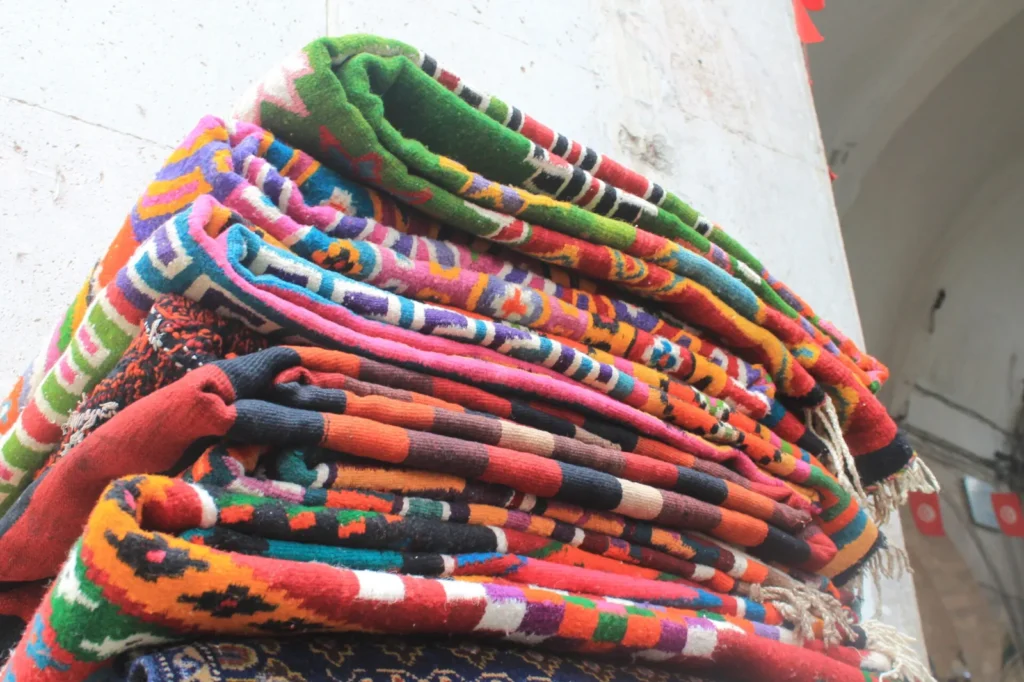
Hand-woven rugs are a living tradition of southern Tunisia, particularly from the Tataouine region. You’ll find fine pieces in specialist shops in Houmt Souk — klim (flat weave), margoum, natural wool. Take your time comparing: a genuine handmade rug can be checked from the back (regular knots, clean wool).
Silver jewellery
The jewellers’ souk in Houmt Souk is known for Berber filigree work — bracelets, necklaces, earrings, and the khamsa (hand of Fatima) crafted by hand. Silver is usually hallmarked; always ask for the stamp and check the purity (800 or 925). Weigh, compare, negotiate.
The art of bargaining, Djerba style
Bargaining is part of souk culture — but it is not a fight, rather a social exchange. Here is how to do it respectfully.
- Greet first. A “salam aleykoum” or simply “hello” opens every door. The trader will reply, and the conversation begins.
- Ask the price, then counter-offer. A loose rule: offer about half the announced price for crafts, a bit more for food (where margins are thinner). Then let the price rise gradually toward a fair middle.
- Accept the tea. If you’re offered a mint tea, sit down. It is not a sales trick — it is Djerbian hospitality. You can absolutely take the tea and buy nothing, thanking your host politely.
- Smile, never push. Bargaining is done with humour. If prices don’t meet, you part with a handshake — no drama.
- Respect the floor price. Past a certain point, the trader can no longer lower without losing. Insisting becomes inappropriate.
One cultural note worth mentioning: during prayer times (particularly dhohr in the middle of the day and asr in the late afternoon), a trader may close their stall for a few minutes to pray at the nearby mosque. This is normal and reflects the rhythm of the island. Wait, or come back a little later.
Opening hours and market days
Djerbian hours are not those of a European shopping centre. Here are the useful benchmarks.
- Morning (7am–1pm): the best time. Fresh produce, lively atmosphere, pleasant light.
- Break (roughly 1pm–4pm): many stalls close for the afternoon rest and the dhohr prayer. Plan accordingly.
- Afternoon (4pm–7pm): partial reopening, mostly for crafts and souvenir shops.
- Ramadan: reversed hours. Markets open later, slow down during the day, and come back to life after iftar until late evening. It is a magical time, but you have to embrace the shifted rhythm.
Weekly calendar:
- Monday: Houmt Souk market (main day)
- Thursday: Houmt Souk market (main day)
- Friday: large Midoun market (the liveliest)
- Every day: Houmt Souk and Ajim fish markets (early morning), daily Midoun fishmonger
Shopping with confidence: meat, fish, avoiding scams
Most food products in Djerba naturally meet halal standards: meat is ritually slaughtered throughout Tunisia, where this is the norm. For full peace of mind, we recommend buying meat directly from a neighbourhood butcher (jazzâr), who will cut the piece to order. For fish, the early-morning markets at Houmt Souk and Ajim are unbeatable for freshness and price.
A few things to watch out for on the crafts side:
- Pieces sold as “silver” without a visible hallmark are often silver-plated metal. Always ask for the stamp.
- “Handmade” rugs that are perfectly regular underneath are usually industrial.
- “Fossils” and “corals” on some tourist stalls are frequently fake.
- Avoid buying under pressure near the big tourist coaches: prices there are often inflated.

Coming home, unpacking, cooking with the family
To truly enjoy the souks, you need a place to come back to — somewhere to lay out your finds, prepare lunch with what you’ve just bought, and take your time. That is precisely what we offer at Ethic Village Djerba: a private family residence of four villas with fully equipped kitchens, about 20 minutes by car from Houmt Souk and just minutes from the Midoun market.
Each villa has its own private pool with no overlooking neighbours, protected by high walls and privacy screens — a truly enclosed garden where families can relax after a morning at the market. Every villa is also equipped with prayer mats, the qibla direction is marked, and the Troujette mosque is a 5-minute walk away for congregational prayer. The residence is strictly alcohol-free — house rules, no exceptions.
To plan your stay, explore our Muslim-friendly villa guide, our family holiday guide and our article on the must-see places in Djerba. And if you’d like a broader picture of the island, our complete activity guide will help you plan the rest of your week.


