

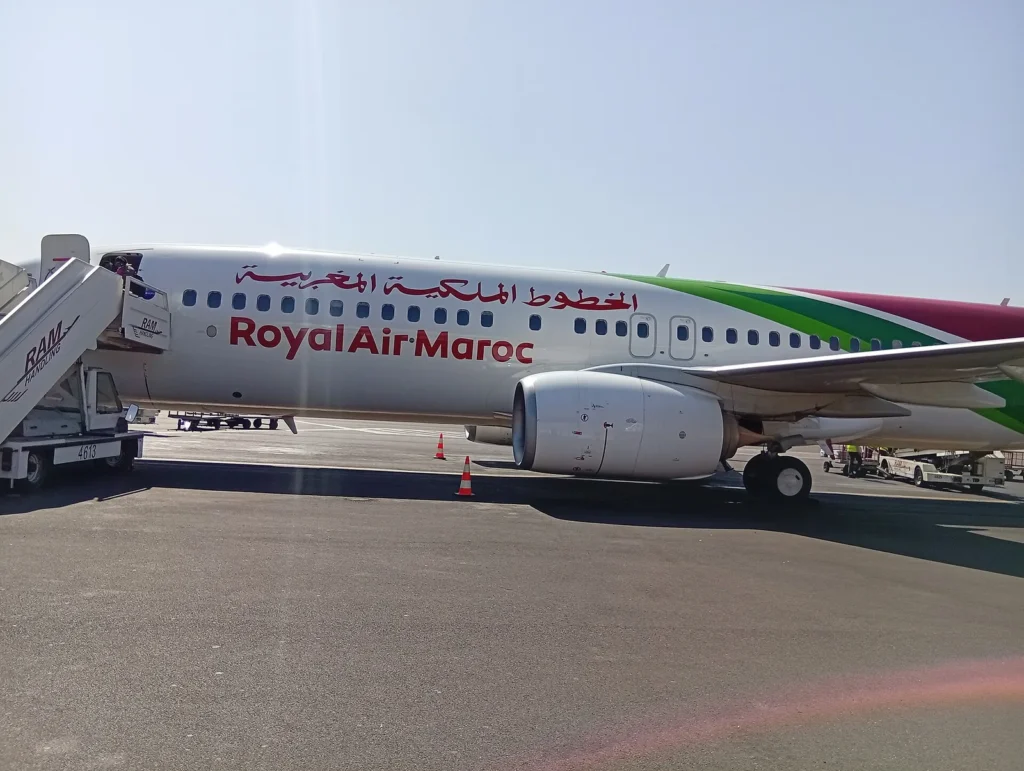
Morocco remains a land of faith and beauty that we hold in deep respect. But when a family from Casablanca, Mohammedia, El Jadida or Settat is looking for a change of coastal scenery — somewhere more intimate than the packed shorelines of summer, on a smaller budget than Agadir or Marrakech — Djerba fits naturally into the picture. The trip involves a connection, but it organises well for a family. Here is how to do it, in 2026, with no detours and no empty promises.
Casablanca to Djerba: the realistic route in 2026
Let’s be plain about it: there is currently no direct flight between Casablanca Mohammed V (CMN) and Djerba-Zarzis (DJE). No airline flies the route non-stop. Every sensible option goes through a stopover at Tunis-Carthage (TUN), followed by a domestic hop to Djerba. Allow 5 to 6 hours door to door with the connection — still very reasonable for reaching an island more than 2,000 km from Casa.
Two other routes exist in theory, but we’d advise against them with a family:
- Via Paris (CDG or ORY): a long detour to the north, expensive connections, and the need to transit through a European airport. Keep this option for special cases (a family visit in France along the way).
- Casa to Tunis, then overland: roughly 7 hours by road between Tunis and Djerba, crossing via the Ajim ferry or the Roman causeway. Out of the question with young children after a 3-hour flight.
The sensible option, then, is CMN → TUN on a direct flight, then TUN → DJE on a domestic hop. The two legs run within the same day, and some airlines sell the whole thing on a single ticket.
Casablanca to Tunis: airlines, frequency, flight time
The Casablanca–Tunis link is well served. Royal Air Maroc flies the leg daily, at around 14 flights a week (two a day depending on the season). Tunisair offers roughly 7 weekly flights, and Nouvelair Tunisie tops up the schedule at certain times of year.
- Direct flight time: about 2 hours 45 minutes (depending on winds).
- Return economy fare: from €180 before taxes (with Royal Air Maroc), averaging around €240–300 outside the summer high season.
- Baggage: RAM’s standard allowance usually includes 23 kg in the hold, which comfortably covers a family suitcase.
For exact timings, check the official Royal Air Maroc site, which publishes up-to-date schedules season by season.
Tunis to Djerba: allow about an hour
Once you’ve landed at Tunis-Carthage, the flight to Djerba is short and runs frequently. Tunisair Express, Tunisair’s regional arm, operates the Tunis–Djerba leg with a flight time of about 58 minutes. Frequency is high — across all airlines, there are close to 118 direct flights a week between the two airports, which leaves plenty of room to plan around your schedule.
- One-way TUN-DJE fare: from €75, with a return average of around €134 on Tunisair Express.
- Connection in Tunis: allow at least 2h30 between your Casa flight landing and take-off for Djerba if you buy two separate tickets. If you take a single CMN → DJE ticket via Tunis (offered by Tunisair and Royal Air Maroc), the airline handles the connection and your bags are checked through to your destination.
A practical tip: go for a single ticket with the connection included rather than two separate ones. The extra cost is small, and you’re covered if the first flight runs late.
The full budget: what a Casa–Djerba family trip costs
For a family of four (two adults, two children), here is a realistic ballpark for a one-week stay in July or August:
- Return flights CMN → TUN → DJE: roughly €1,600 to €2,200 for four tickets in high season (expect less off-peak).
- Airport-to-villa transfer in Djerba: €35 to €55 by private taxi or pre-booked shuttle, depending on the vehicle. The details are gathered in our Djerba airport transfer guide.
- Private villa with a pool: in Djerba, count on €200 to €300 a night for a quality family villa in high season. For comparison, an equivalent villa on the Moroccan coast (Agadir, Taghazout) sits closer to €400–500 a night in summer.
- Meals and groceries: Djerba stays very affordable. A family dinner out costs between €25 and €50 depending on the place, and the local markets let you cook at the villa on a modest budget.
- Car hire on the island: €40 to €70 a day for a compact saloon, handy for exploring at your own pace.
Overall, the “accommodation + dining” line comes in noticeably lower in Djerba than in Agadir or Marrakech for comparable quality. That difference goes some way towards paying for the flights. To dig deeper into the comparison, see our article Djerba or Morocco: where to go for a halal-friendly family holiday.
Visa, passport, currency: what to know before you go
Visa: Moroccan nationals enter Tunisia without a visa for a tourist stay of under 90 days. Simply showing your passport on arrival is enough. This ease, the fruit of bilateral agreements between the two countries, is one of Djerba’s great practical advantages for families from Casa.
Passport: since 2026, your passport must be valid for at least 3 months beyond your planned return date. Check the expiry date for every member of the family — children included, whose passports can be close to renewal without anyone noticing. If a passport falls short, an express renewal through the Moroccan authorities usually takes 7 to 10 working days.
Currency: the local currency is the Tunisian dinar (TND), which is non-convertible outside Tunisia. You can neither buy it in Casablanca nor bring it home beyond a token amount. The simple fix: change money on arrival at Tunis or Djerba airport (exchange desks are open for every international flight). The rate is regulated and the same everywhere. Your Moroccan bank card works in most hotels, restaurants and larger shops in Djerba.
Djerba for Moroccans: what changes, what feels familiar
Many Moroccan families discovering Djerba for the first time are struck by the sense of familiarity — and by a few welcome differences.
What feels familiar
- The language: Tunisian Arabic differs from Moroccan darija, but mutual understanding holds up well, and classical Arabic works everywhere. French is widely understood in tourism and services.
- The food: couscous (UNESCO-listed), tajines (different from the Moroccan ones, but cousins), briks, cooked salads, dates, harissa, mint tea. The culinary ground is familiar, with its own accents.
- The rhythm of faith: the call to prayer five times a day, mosques everywhere, Friday observed, Ramadan lived collectively. The Muslim fabric is the same.
What changes
- The scale: Djerba is a compact island. The main sights are about 30 minutes’ drive from the villas — a contrast with Morocco, where Marrakech–Agadir or Marrakech–Essaouira mean several hours on the road. Fewer transfers, more time together.
- The island atmosphere: Djerba keeps a gentleness, a slower pace, a sense of family modesty that the big Moroccan Atlantic resorts have partly surrendered to the crowds. The island has been on the UNESCO World Heritage list since 2023 for its vernacular fabric of villages and mosques.
- The private villa format: in Djerba, it’s easy to rent a single-storey villa with a private pool and an enclosed garden, without overlooking neighbours and with no alcohol in the shared areas. This formula, a firm favourite with families who want calm and privacy, is less common in mainstream Moroccan coastal resorts.
More and more Moroccan diaspora families (MRE) living in France or Belgium are choosing Djerba as an alternative to Morocco for their summer break — a direct flight from Paris in 2h30, prices kept in check, a calmer setting. Families from Casa are discovering the same route in turn.
FAQ — Casablanca to Djerba
Is there a direct flight from Casablanca to Djerba?
No. In 2026, no airline flies CMN-DJE non-stop. The trip always goes through a stopover in Tunis, which can take the form of a single ticket with Royal Air Maroc or Tunisair (connection and baggage handling included).
How long does the door-to-door journey take?
Allow 5 to 6 hours between take-off from Casablanca and landing in Djerba, including the connection: about 2h45 in the air CMN-TUN, 2h to 2h30 of layover at Tunis-Carthage, then an hour’s flight to Djerba.
Do you need a visa for Tunisia from Morocco?
No. Moroccan nationals enter Tunisia without a visa for a tourist stay of under 90 days, on simply showing their passport. Do check that it is valid for at least 3 months beyond your return date.
When is the best time to go with the family?
May–June and September–October offer the best balance: sea at 22–26°C, warm but bearable days, sensible crowds and gentler prices. July–August is still workable, with heavier footfall and flight prices to book several months ahead.
How do you reach the villa from Djerba airport?
Djerba-Zarzis airport is about 20 minutes’ drive from the villa area. A pre-booked private transfer is the simplest option for a family, especially after a day of travel with a connection — details in our airport transfer guide.
Planning your family stay in Djerba
The journey from Casablanca calls for a connection, but the arrival is worth the patience: a Muslim island on a human scale, food that speaks to your palate, and the chance to rent a private villa with a pool, alcohol-free, in an enclosed garden, within reach of a mosque. If you’d like to discover our four single-storey villas (Diamant, Saphir, Opale, Jade), each with its own pool and garden, the team is on hand to answer your questions about the halal-friendly format and to arrange your arrival.
May Allah make your journey easy and your family reunions joyful.